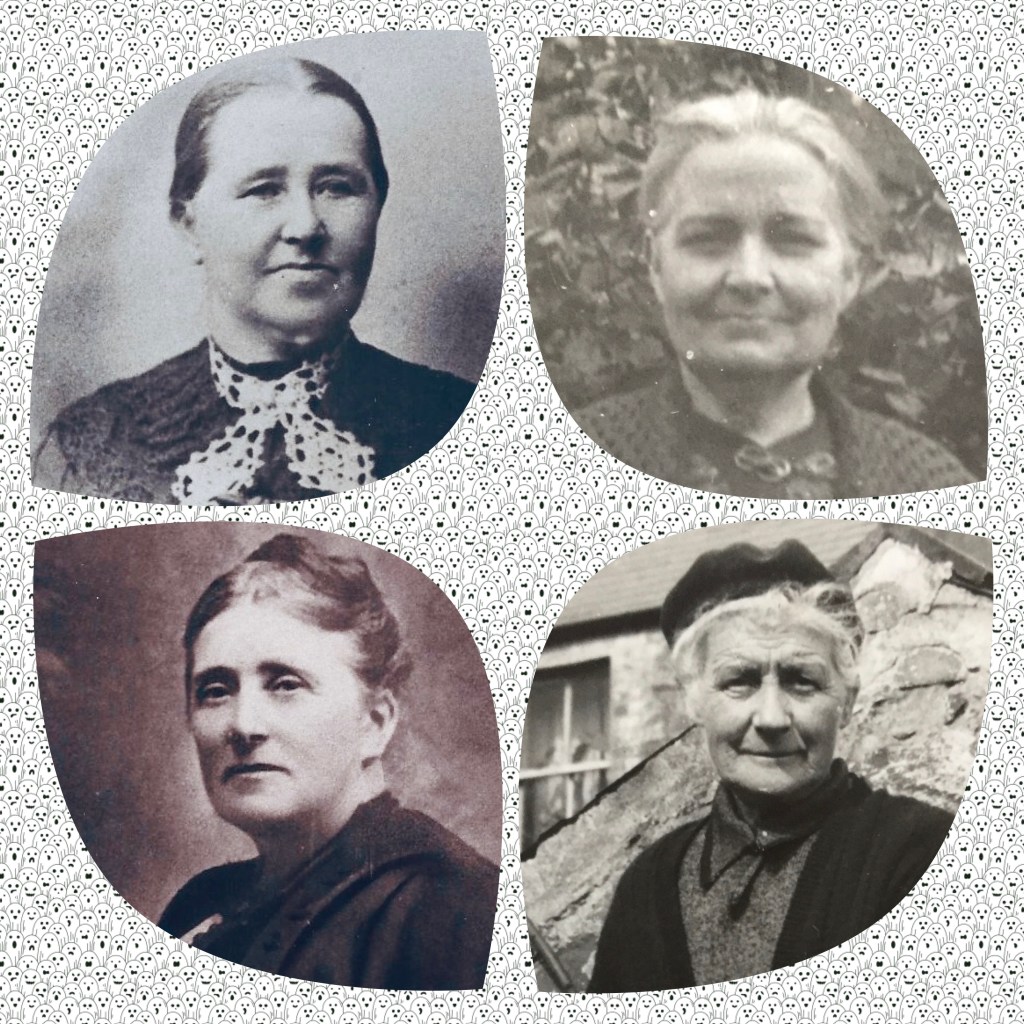
My four great-grandmothers: Top Left, Agnes McCracken, nee Kidd, 1839-1922. Bottom Left, Eliza Ann Ingram, nee Cromie, 1855-1921. Top Right Olive Johnston Curlett, nee Jones 1867-1928. Bottom Right, Grace Leslie Oliver, nee Johnston 1870-1944.
Mitochondrial Musings for (American) Mother’s Day
I was thrilled to find that I had photographs of all four of my great-grandmothers. And, trying to get a little more polished in my presentation, I have been working on an app (LiveCollage) on my phone which has myriad backgrounds and formats for displaying photos. All was well and good as I created to my heart’s content. I was delighted with the result, that was until I saw the photo on my laptop screen. The background that I had chosen as the best color to tie the photos together had a spooky Halloween theme! After panicking and tinkering for a bit it occurred to me that the little ghosts, rather than being out of place, were quite fitting. They are there representing all the women who came before, the mothers upon mothers upon grandmothers I will never know.
Although these four ladies’ names have always been known to me, the only one I really felt a personal connection to was Grace (Johnston) Oliver. In childhood I was often with Grace’s daughter, my maternal grandmother, Maisie (Oliver) Johnston and heard the stories of her life. Grace died fifteen years before I was born, but when I was a teenager I was given a personal memento, her wedding ring, which I wear on the middle finger of my right hand to this day. I wore the ring, a wide rose-gold band, in the early days because I liked it and thought nothing of the significance. Now it seems appropriate, the mother-daughter-mother-daughter bond is strong and the older I get the more I see what I inherited from my mother, my grandmother and by extension my great-grandmother and beyond. And genetically speaking, Grace is the source of my mitochondrial DNA (mtDNA).
Not to Get Too Technical
MtDNA is the tie that binds. Passed from a mother to all her children, male and female, it is passed on only by her daughters. Our mtDNA stretches back in an unbroken line through our maternal ancestors remaining unchanged from generation to generation. Mutations do occur but rarely. This means that for genealogists, mtDNA is not very useful as we match so many people in the same way, but occasionally it can be helpful to resolve specific problems. Ever curious about my own DNA, I had both my mtDNA and my father’s tested. While my Dad had hundreds of matches, I was surprised to discover that I had only nine, none of whom seemed to have the remotest possibility of being related to me in recent time. It turns out I belong to a relatively rare mtDNA group, I3. And as I looked into my own family I realized that I would need to go back at least to the early 1800s to find matches if any existed. I am an only daughter as was my mother. My grandmother had three sisters, but none of them had children, my great grandmother, Grace (Johnston) Oliver had two sisters, one died as a teenager from tuberculosis, the other sister, Rebecca (Johnston) Lockwood, had two daughters, neither of whom had children. This takes us back to Grace’s mother, my great-great-grandmother, Mary Kee. I do not know if Mary had sisters, she was born about 1833, long before birth registration began in Ireland.
Oliver and Lockwood Families
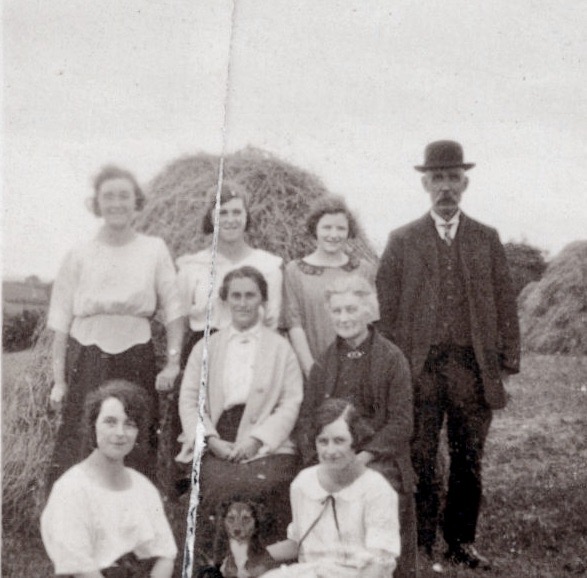
Taken in the late 1920s, here’s a fuzzy photo of my mitochondrial family plus my great-grandfather, Thomas Oliver, in the fields at Drumcaw, Co. Down. Left to right back row: Maisie Oliver, Annie Oliver, Ray Lockwood. Seated ladies: Rebecca (Johnston) Lockwood and Grace (Johnston) Oliver. Kneeling in front Eva Oliver and Ena Lockwood. (I don’t know the dog’s name!) Only Maisie, my grandmother, had children.
Like every genealogist whose family hails from Ireland, north and south, I know the chances of finding records before 1800 to prove any DNA connection, mitochondrial or otherwise, are slim to remote, but, like every genealogist everywhere I live in hope that one day the very document I need will turn up!
It struck me that while I could not add any rungs to the family tree with my DNA, I could see the subtle effects of that mother to daughter inheritance in my own life. The unconscious patterns we learn at our mother’s knee remain strong in us. How many times did I find myself doing or saying something with my children that made me think of my mother? Uncountable. And now I see my own daughters as mothers and reflect on the same patterns repeated. So much is different from generation to generation and yet we have a common framework we draw on.
I finish here with a poem that I wrote a couple of years back as I reflected on Grace (Johnston) Oliver’s ring.
The Keeping Ring
The hand that clasped and kissed the infant’s fists
was first the baby’s hand that stroked her mother’s breast
was the hand that clasped and soothed her kin,
was later soothed herself, in death,
was the hand that wore the ring I now wear on mine.
The hand that clasped, kept close the ring,
was the hand that bent and trimmed her daughters
in the cradle customs of rebuke and joy,
was the hand that gifted me
with the minute skills of motherhood.
The hand that clasped, kept close the ring,
held fast,
unbroken in the chain of hands,
that stitched for me a teasled thread of
precious gifts from
all the grandmothers I will never know.
Lyn Lloyd-Smith 2021
 Gathering the Ancestors
You must be logged in to post a comment.