The first post in this series: https://archivedust.org/2024/08/12/inheritance/
The second post in this series: https://archivedust.org/2024/09/02/inheritance-part-2/
Quick Summary of Findings So Far
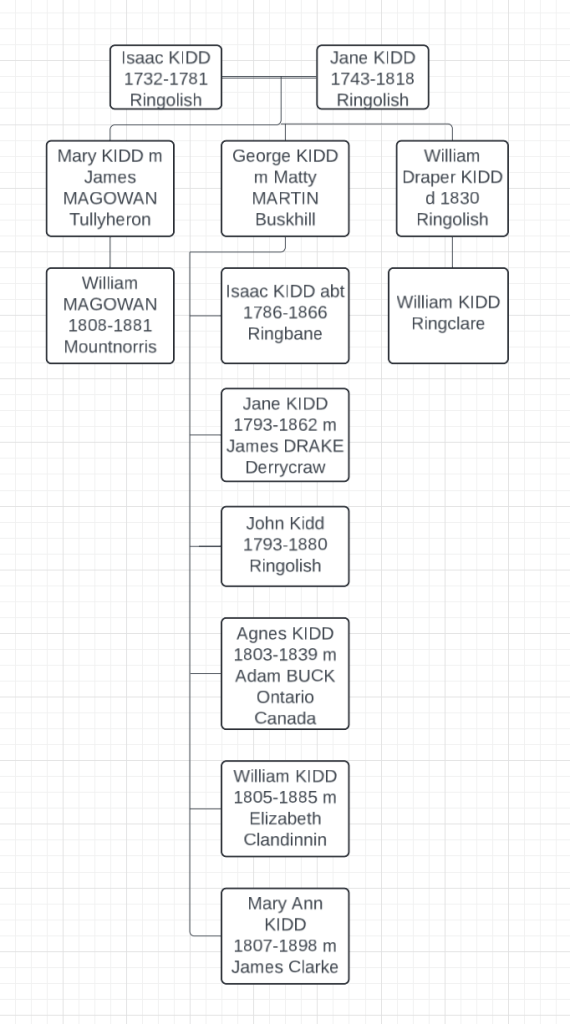
What have we learned of the Kidd Family from the will of William Draper Kidd, the family letters, newspaper articles and other documents? (see Family Tree left) I already knew that my ancestor William Kidd 1805-1885 of Buskhill, Donaghmore was the son of George Kidd of Buskhill and his wife Matty Martin. From the various sources I discovered there were two other sons, Isaac and John, and three daughters, Jane Kidd Drake, Agnes (Nancy) Kidd Buck and Mary Ann Kidd Clarke. George Kidd’s parents were Isaac and Jane Kidd. His brother William Draper Kidd, whose will is preserved at the Public Records Office of Northern Ireland (PRONI), seemed to have inherited and held the leases of the family farms, even though his nephews, John and Isaac Kidd were tenants in two of them. Draper left all the land in his will to his son William Kidd and disinherited his nephews Isaac, John and William. Much litigation followed over the space of 24 years with the executor, James Harshaw, ignoring some of the provisions of Draper Kidd’s will and seeking the division of the property between the the descendants of Isaac and Jane Kidd’s three children, William Draper Kidd, George Kidd and Mary McGowan. Finally in 1854 the case was settled and Isaac and John Kidd were required to sell their land and share the proceeds between their siblings and cousins.
Discovering James Harshaw’s Diaries
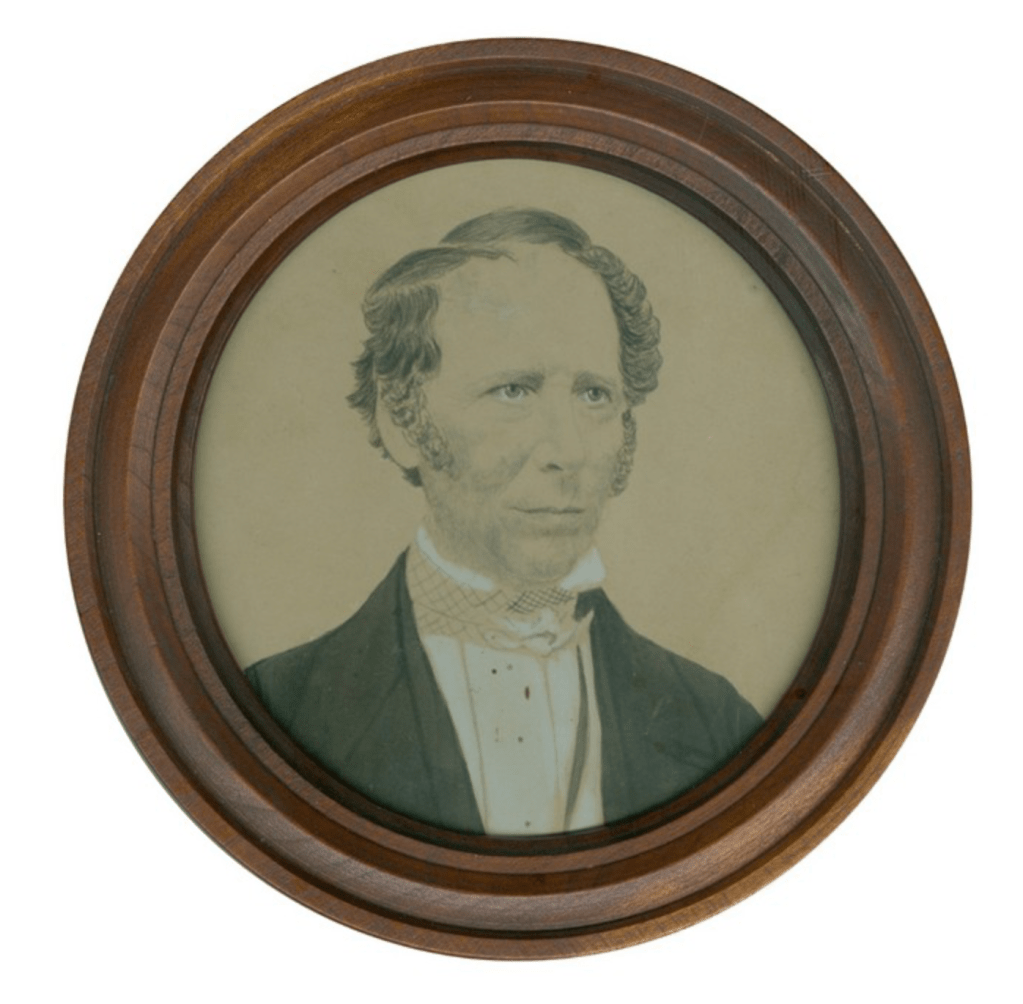
Left: Portrait of James Harshaw 1796-1867 donated to the Newry Museum by Marjorie Harshaw Robie in 2023
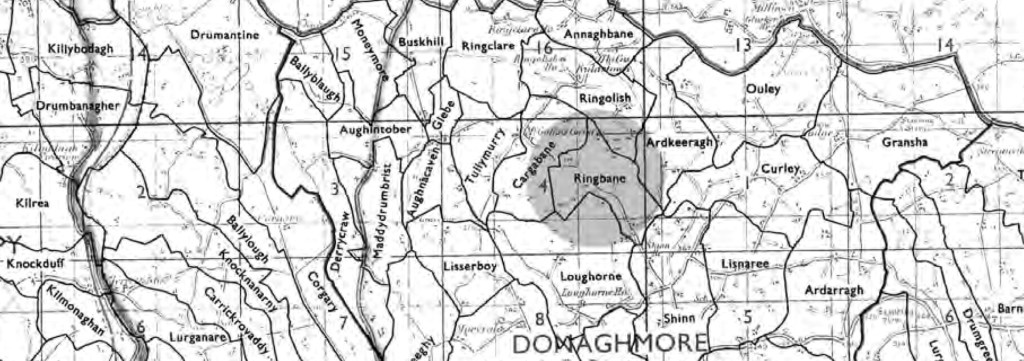
I mentioned in the first installment of Inheritance https://archivedust.org/2024/08/12/inheritance that William Draper Kidd’s will of 1824 survived because it was included in the diaries of James Harshaw of Ringbane, Donaghmore, Co Down . These diaries detail the workings of James’ farm, the activities of his family, the many wills he writes for his neighbouring farmers, and births marriages and deaths among his friends, family and acquaintances. The diaries went to America with one of James’s sons in the 1890s and were rediscovered in a bank vault in Ohio in the 1990s, eventually making their way into the hands of a descendant, Marjorie Harshaw Robie. Marjorie recognized their importance and donated them to the Public Records Office of Northern Ireland (PRONI). She also made a transcription which I recently discovered was available on Family Search. https://www.familysearch.org/library/books/records/item/46467-james-harshaw-s-diaries As so often we benefit from the work of others. I am always grateful for those that have created indexes, documents, pieces of research that aid us in our own journey of discovery. Here is a link to a Facebook post written by Suzanne Ballard, Marjorie Harshaw Robie’s cousin, on the Old Newry page that details the survival of the diaries. https://www.facebook.com/groups/1460077644050274/posts/5190135004377834/
Compulsive Reading
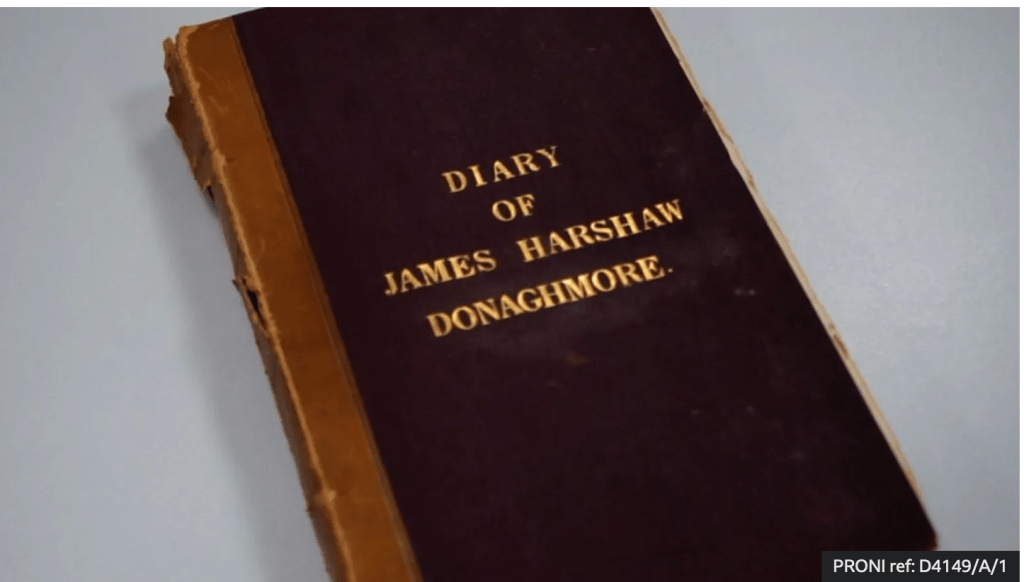
left: The PRONI copy of James Harshaw’s diaries with their PRONI reference (downloaded from a BBC article)
I admit that a 19th century diary is not everyone’s idea of a page turner, but I was completely immersed. It was familiar yet provided valuable new information; I found myself reading every page. I recognized the way of life, the rhythm of the farm work, the trips to the fairs and markets, the noting of the neighbors’ comings and going. In its pages I heard the echo of the stories my father, Bertie McCracken, told of his growing up, almost a century later, in the 1920s and 1930s in a County Down farming community.
Kidds Galore
There is so much material in this diary. With the restraints of a blogpost I can only dip into and reflect on the new information. But there is more, so much more detail. There are constant references in the diaries to Kidds:
- sometimes including a Christian name, Hurrah!
- sometimes Mr, Mrs or Miss Kidd.
- very occasionally, but helpfully, giving a name in connection with a townland.
- James Harshaw’s wife was Sarah Kidd, the daughter of William Kidd of Kiddstown, Ringolish, Donaghmore, so some of the Kidds referred to will be her family and she may well have been related to Draper Kidd in some way.
- Bear in mind, there were many Kidd families in the parish of Donaghmore. How all these people interlock with each other is by no means clear.
Genealogical Gold

Undoubtedly the most important information for me in the diary was in James Harshaw’s 1849 farm accounts where he gives an extract from the book of Wm Kidd (Draper). This outlines the dates of death and ages of Draper’s parents, Isaac and Jane Kidd (see below). This is treasure indeed. One family tree I was sent claimed that James Harshaw was Draper Kidd’s brother in law. However, this extract shows that Isaac and Jane could not have been the parents of Sarah Kidd as Isaac was dead almost 20 years before she was born. Draper Kidd’s book may not have survived but this valuable family history has.

Notes of an Executor

James Harshaw records his days without judgement. At times of family difficulties and tragedy he is lyrical. Often when he records a death he mentions something good about the character of the deceased. I would have expected some exasperation from him in the ongoing dispute with the Kidds but his entries are factual. Indeed he appears to continue to conduct farm business with Isaac Kidd. What becomes clear quite quickly is that James is close friends with the other two legatees, Draper Kidd’s son, William Kidd and Mary Magowan’s son, William Magowan. They visit often in each others houses and go to fair days together.
Referencing the Dispute
- 1845 The first mention of the litigation in the diaries does not come until 6th November 1845 when James writes that Isaac and John Kidd were served with notice from William Kidd and William Magowan. This is puzzling as in the court documents, that we saw in the newspaper reports, William McGowan is listed as one of the defendants in the case. Was this a different court case?
- 1846-1848 Through 1846 and 1847 there are references to bills being served and answers being filed. In February 1848 ‘John and William Kidd read papers to Mr and Mrs Drake.’ It feels like there is an uneasy, shifting set of alliances going on with various family members litigating against each other at different times. By no means all of these bills and filings made the newspapers. Linking these disparate references together is difficult.
- Then, a shocking note on 28th September 1848 says ‘John and Isaac Kidd arrested for Mr Kidd by Vanard’ and 29th September 1848 ‘John and Isaac Kidd sent to Downpatrick.’ The County Gaol was in Downpatrick so this appears to be what is meant. Family relations had reached a new low! However, as John and Isaac keep on farming and going about their business they can’t have stayed long in the County Gaol.
- 1848 This is included in James’ 1848 accounts as follows: ‘Ringclare 1848. To Mr James Harshaw.I request you will proceed with this suit and enforce my just claims for a division of the lands at present held by Defendants, John and Isaac Kidd, according to my father’s will, and as executor, and I hereby indemnify you against all costs incurred by you, as such executor, or to be incurred in carrying on this suit. William Kidd.’ Does this show that William Kidd was frustrated with the lack of progress in the case? I would have been if it was my inheritance!
- 1849-1854 Through 1849 and 1850 the reflections on the case continue. In July 1849 James notes that the Kidds case appeared in the (Newry) Telegraph. During these years witnesses are examined by both sides at solicitors in Newry. In Feb 1852 James Drake’s death is noted and in December 1852 the diary states that Mrs Drake obtained a verdict against John Kidd. A few references are made in 1853 about visits to Dublin re the Kidd case and then in September of 1854 James writes that he attended the auction of the Kidd’s farms in the Four Mile House.
Postscript
If James Harshaw thought that all difficulties with the Kidds were over with the sale of the farms, he was wrong. On 20th July 1855, he records ‘William Kidd of Ringclare (Draper’s son) breakfasted here this morning , after which he proceeded to serve a 10 day notice on William Kidd of Ringbane and Robert Kidd of Ringolish to pay out the purchase of their farms.’ So William Kidd had gone from one set of Kidds, John and Isaac, to another set of Kidds, William and Robert, owing him money! William Kidd of Ringbane is probably Isaac’s son who will go on to inherit Isaac’s farm in 1866, he seems to have already been managing the property in 1855, although Isaac’s name is still listed as the tenant in the Griffiths Valuation of 1864. I do not know who Robert Kidd is, but there may be other helpful clues in the pages of the diary.
Conclusion
Finally, on 29th June 1860 James Harshaw writes ‘met William Magowan and William Kidd in Mr Todd’s Office where we agreed to settle the Kidd’s lawsuit and directed Mr Todd it be would up by distribution of the £920 by the sale of the Ringolish farm and six and a half acres of the Ringbane farm.’
Was the distribution only to William Magowan and William Kidd, or did it include the children of George Kidd? We cannot tell at this distance, but the details found on this court case go beyond anything to be expected in 19th century Ireland. This insight into the life and times of the Kidd family of Donaghmore helps us envisage a cultural environment both familiar and alien to us. We come a step closer to understanding the lives of our ancestors.

 Gathering the Ancestors