Court of Chancery in Dublin: The Kidd Family Inheritance Dispute
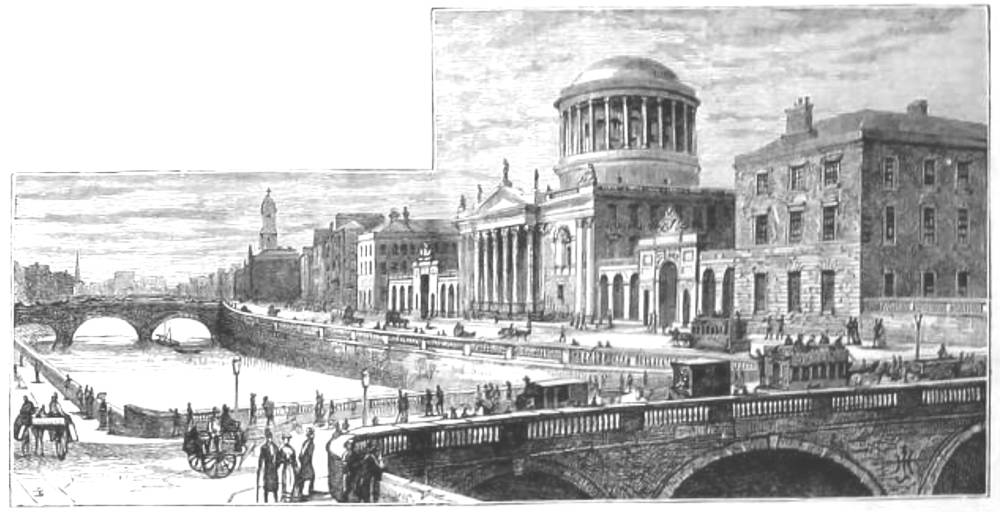
A sketch of the Four Courts in the Dublin where the Court of Chancery sat. How intimidating would this have been for country farmers?
Quick Summary of the Inheritance Story So Far
In researching my great great grandfather William Kidd of Buskhill, Donaghmore, County Down 1805-1885 I came across the 1824 will of William “Draper” Kidd of Ringolish, Donaghmore, County Down. Two younger William Kidds, a son and a nephew, are mentioned in the will but it is not clear if either of these are my ancestor.
New clues turned up when my father, Bertie (Hugh) McCracken, William Kidd of Buskhill’s great grandson, did an autosomal DNA test on Family Tree DNA (FTDNA) in 2017. A distant DNA cousin, Gary Clements, had correspondence from the 1820s and 1830s between Kidd family members in Donoughmore and Agnes (Nancy), mentioned in the will, who lived in Canada. Her brother William Kidd, is referenced in the letters and it seems likely that he, given the DNA connection, was my ancestor. The letters give details of a court case that arose from the terms of the will.
Lucky Source No 3: What the Newspapers Said
When there’s a will and a court case, then the papers take an interest. Some things don’t change! Is there any further information to be gained about the Kidd family from these newspaper accounts? Fortunately many newspapers are now searchable online at https://www.britishnewspaperarchive.co.uk including several from County Down. Let’s take a look at what they say.
Newry Telegraph 5th November 1830
Sale By Auction
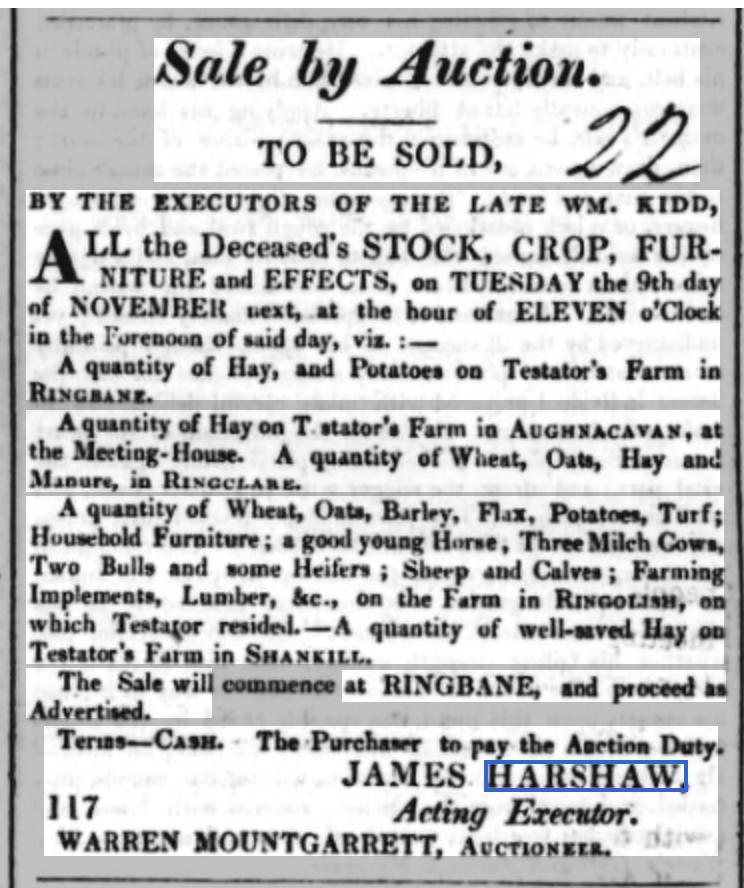
We know from the family letters that Draper Kidd died in October 1830. Soon afterwards James Harshaw, as the acting executor, advertises an auction for the crops, animals, implements etc. at the various farms owned by William Draper Kidd, Ringbane, Aughnacavan, Ringclare, Shankill and the farm where Draper had resided in Ringolish. Draper was evidently a prosperous farmer who either owned or leased land in five different townlands.
The family letters show that there are already legal proceedings going on soon after the death of Draper in 1830 but there is no mention of the court case in the newspapers until 1849.
Newry Telegraph 11th July 1849
Bill in Chancery
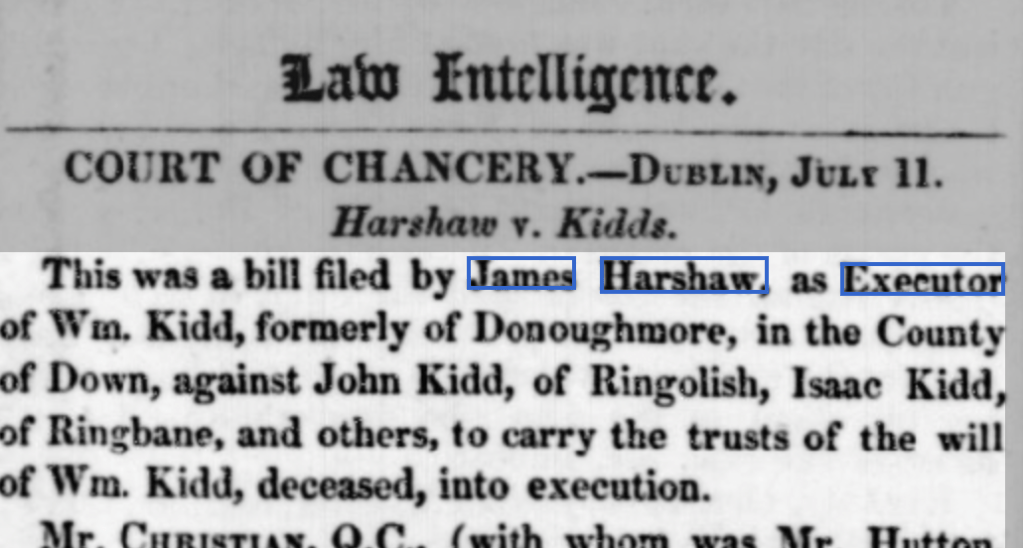
The bill that came before the Court of Chancery in Dublin shows James Harshaw as executor of William Kidd formerly of Donoughmore, as plaintiff, and John Kidd of Ringolish and Isaac Kidd of Ringbane, and others as defendants.
The language is long and complicated, but the gist of the complaint is that shortly after the death of William Draper Kidd, John and Isaac Kidd forcibly took possession of the two farms, about 40 statute acres, valued at £1600, and have remained in them ever since. This, despite repeated applications from James Harshaw that they should divide the land amongst the three parties legally entitled to it. The original leases of the land dating to 1753 and 1796 respectively had been in the name of Isaac and Jane Kidd.
Division of property
It seems that the three parties legally entitled to the land are three of the children of Isaac and Jane Kidd the original lessees, or their descendants:
- Their eldest son William Draper Kidd who left all his land to his son William Kidd,
- Daughter Mary Magowan and her son and heir William Magowan,
- The six children of their second son, George Kidd, Isaac Kidd, John Kidd, William Kidd , Jane (Kidd) Drake, Nancy (Kidd) Buck and Mary Ann (Kidd) Clark.
Lord Chancellor’s Ruling
The Lord Chancellor ruled for the executor of the will, James Harshaw. John and Isaac Kidd must vacate the properties. The exception to this ruling is 4 acres of Isaac Kidd’s farm in Ringbane which were made over to him by his grandmother, Jane Kidd, and so excluded from the settlement.
Notice here that James Harshaw has shifted position from the original requirements of Draper’s will in which nothing was to be left to George Kidd’s sons, William Magowan was to get £100 and all the land was to go to Draper’s son, William Kidd. Now the property was to be divided threefold.
Newry Telegraph 15 December 1849
Decree in Chancery
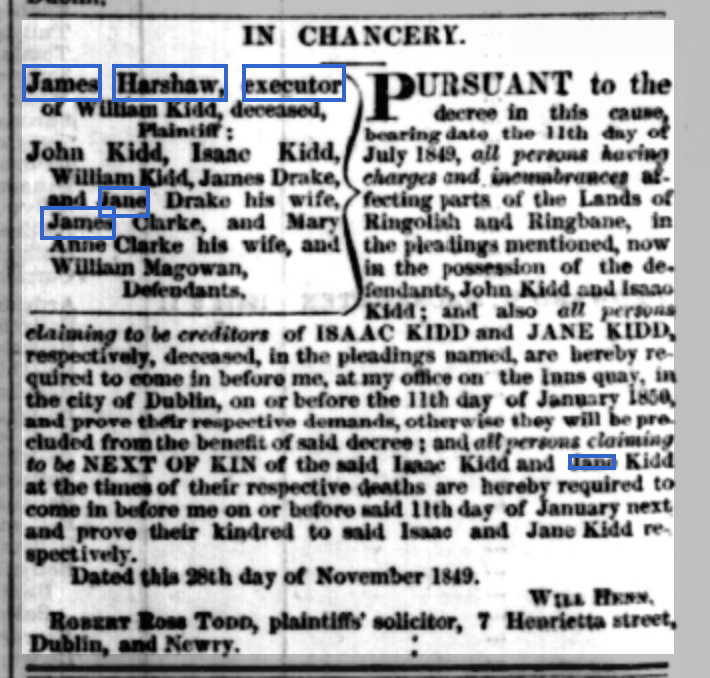
A notice was placed in the Newry Telegraph about the court case, this time naming all the defendants as John Kidd, Isaac Kidd, William Kidd, James and Jane Drake his wife, James Clarke and Mary Ann Clarke, his wife and William Magowan. It required anyone with claims affecting parts of the lands of Ringolish and Ringbane, in the possession of John and Isaac Kidd, and also all persons claiming to be creditors of, or next of kin to, Isaac and Jane Kidd, deceased to come in to the solicitors in Newry or Dublin to prove their claim before the 11th of January 1850.
List of Defendants
Helpfully, this time the entire list of the defendants names is given. It includes the three Kidd brothers and two of their sisters, Jane Drake and Mary Ann Clarke. The third sister Agnes (Nancy) Buck is not mentioned. A tree on Ancestry.com for the Buck family shows that Nancy died in 1839 so this may be why she is not included, but what of her children? Did her family ever get the money she was left in Draper’s will? And again, what of the other William Kidd, Draper’s supposed illegitimate son?
Whether or not the defendants did register their claims, nothing is reported of the Kidds and their litigious activities until 18 months later.
Newry Examiner and Louth Advertiser 23rd August 1851
The Drakes go to Court
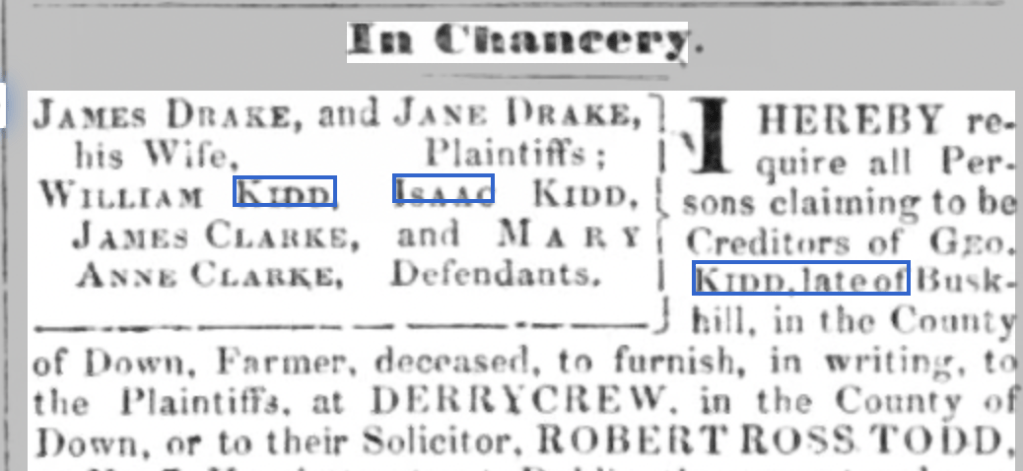
This time it is James and Jane Drake who have a case in Chancery against Jane’s brothers, William and Isaac and sister and brother-in-law, Mary Ann and James Clarke. Apparently it is now the settlement of their father’s estate which is at issue. The notice requires all those that are creditors of George Kidd, late of Buskhill in the County of Down, farmer, deceased to provide in writing to the plaintiffs their respective demands. Interestingly the Drakes use the same solicitor, Robert Ross Todd, who has taken then to court over Draper’s will!
George Kidd of Buskhill probably died before 1824, as he is not mentioned in Draper’s will or in the letters written to Nancy in Canada. Is it odd that it has taken so long to settle his estate? Or was this quite normal in rural Ireland?
Newry Examiner and Louth Advertiser 9th August 1854
Auction of the Kidd Farms Scheduled
And at last, The Harshaw v Kidd cases draw to a close. “Pursuant to a decree made in this case bearing date 29th April 1853 the lands of Ringbane in possession of Isaac Kidd, 10acres, 2 roods, 30 perches Irish Plantation measure and the lands in Ringolish now occupied by John Kidd containing 14 acres Irish Plantation measure are to be sold at auction at the Four Mile House (an inn) in Donaghmore on 26thSeptember 1854.” This decree is effectively enforcing the ruling of 1849 in favor of James Harshaw. Twenty Four years after Draper Kidd’s death his affairs can finally be settled.
Newry Telegraph 5th October 1854
The Land is Sold
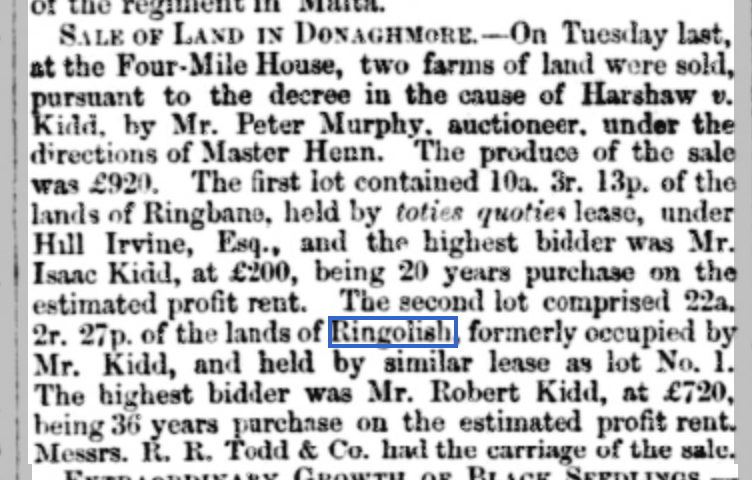
The newspaper reports the sale of the lands of Ringbane and Ringolish that have caused so much trouble for a quarter of a century. Strangely the acreage of the land is not the same as in the decree from Chancery. The difference in John Kidd’s land in Ringolish can be explained by the use of two different methods of measurement. The court degree refers to what was known as Irish Plantation measure, while the sale report refers to the same acreage in Statute Acres. Nevertheless, that does not explain the difference in Isaac Kidd’s farm which is only a few perches. Isaac Kidd appears to have bought back his own land and a Mr Robert Kidd bought John Kidd’s land. Possibly he was Isaac’s son. Whoever bought the farms, 10 years later at the time of the Griffiths Valuation of Ireland, Isaac Kidd is still occupying 17 acres in Ringbane and John Kidd is still occupying 10 acres and change in Ringolish.
Conclusions
So what conclusions about the Kidd family can we make as a result of these newspaper reports?
- Draper Kidd’s brother was named George Kidd and was the father of Isaac, John and William Kidd, Jane Drake, Nancy Buck and Mary Ann Clark. Jane and James Drake seem to have been the executors of George Kidd’s estate and many years after his death took their siblings to court to finish the settlement.
- George and Draper’s parents were Isaac Kidd and Jane Kidd. They also had a daughter Mary Magowan. Their affairs seem to not have been well settled with Draper inheriting all the family leases even though George, possibly, and his sons Isaac and John, certainly, farmed two of the leases.
- My It would appear that my ancestor William Kidd, the youngest son of George, inherited the Buskhill farm from his father, while the older sons Isaac and John inherited property from their grandparents.
- Jane and Isaac Kidd, my 4 times great grandparents, are new names to add to the Family tree, taking it back into the middle of the 18th century.
Surprisingly, as I was writing this story, yet another source turned up to fill in some of the gaps. Do you remember that Draper Kidd’s will survived because James Harshaw had kept a copy of it in his diary? I knew that the diary was held by the Public Records Office of Northern Ireland (PRONI), but I have only recently discovered that there is a transcription of it on the FamilySearch website at: https://www.familysearch.org/library/books/records/item/46467-james-harshaw-s-diaries. So my homework is to read through and learn of James Harshaw’s perspective on this seemingly endless court case. I hear the diary is very long!
Keep you eyes open for Inheritance Part 3

 Gathering the Ancestors
One thought on “Inheritance Part 2”