Unravelling Forgotten Family Stories- A tale of Inheritance from 19th Century Ireland
Irish Genealogy can be very frustrating. Have I mentioned that before? if I haven’t I’ll need to keep repeating it again and again! A combination of circumstances; lack of original record keeping, poor decision making, and the destruction of the Public Records Office in Dublin in 1922 which consumed centuries of wills, court documents, Church of Ireland records and many other treasures, mean that records relied on for tracing family trees in other countries, do not exist in Ireland. Fortunately, in recent years tracing your Irish ancestry in the 19th and early 20th centuries has become much more accessible with the surviving 1901 and 1911 census returns online at www.census.nationalarchives.ie and births, marriages and deaths from mid 1800s onwards at www.irishgenealogy.ie. And, what’s even better, both of these sources are free.
But , to go further back in time, we need to hunt for alternative sources and with a bit of luck, and I mean luck, sometimes it is possible to piece together a family story from disparate documents and online repositories.
This is the convoluted story of one such piece of research from my own family.
Lucky survival Number One: Where There’s a Will
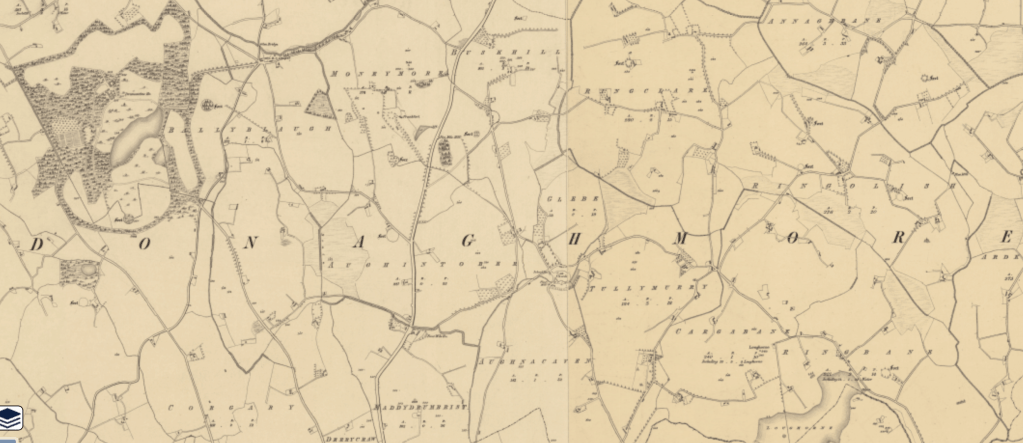
In May of 1824 William Kidd, known as Draper Kidd, of Ringolish, Parish of Donaghmore, Co Down,(you can see it faintly in the header map) wrote his last will and testament. The document rambles a bit, but essentially Draper provides for the six children of his brother. The sons, Isaac Kidd, John Kidd and William Kidd, are to inherit land, and the daughters, Jane (later Jane Drake), Agnes (later mentioned as Nancy , a common pet name for Agnes at this time. Her first husband named Dick and second Buck) and Mary Ann (later Mary Ann Clark) are to receive money. He also leaves £100 to his sister Mary Magowan’s son William Magowan.
Draper, I will call him Draper as there are too many Williams in this story, grudgingly provides up to £50 for his own son, John Kidd, appearing to deny that he married John’s mother, saying bluntly, “respecting that woman in County Armagh that people say I married that she call Grimes”. He also leaves all his land to another son, William Kidd, when he reaches the age of 21.
At some point Draper writes a codicil to his will, “For bad conduct of my brother’s sons I now revoke their parts of lands in this will and not allow them any part thereof. I mean Isaac and John and William. Three brothers nor any chattels but what their father and them got from my mother and me already.” Clearly he was not happy with his Kidd nephews.
Given all the proverbial headwinds and hurricanes in the preservation of Irish records, how did this will survive? Why didn’t this document fly in incinerated fragments across the streets of Dublin in 1922? The answer lies with James Harshaw, a farmer and prominent citizen in the townland of Ringbane, the neighbouring townland to Ringolish, in the parish of Donaghmore, who kept a detailed diary over many years. James was the executor of Draper’s will and kept a copy of it in his diary. Both diary and will are now held at the Public Records Office of Northern Ireland (PRONI).
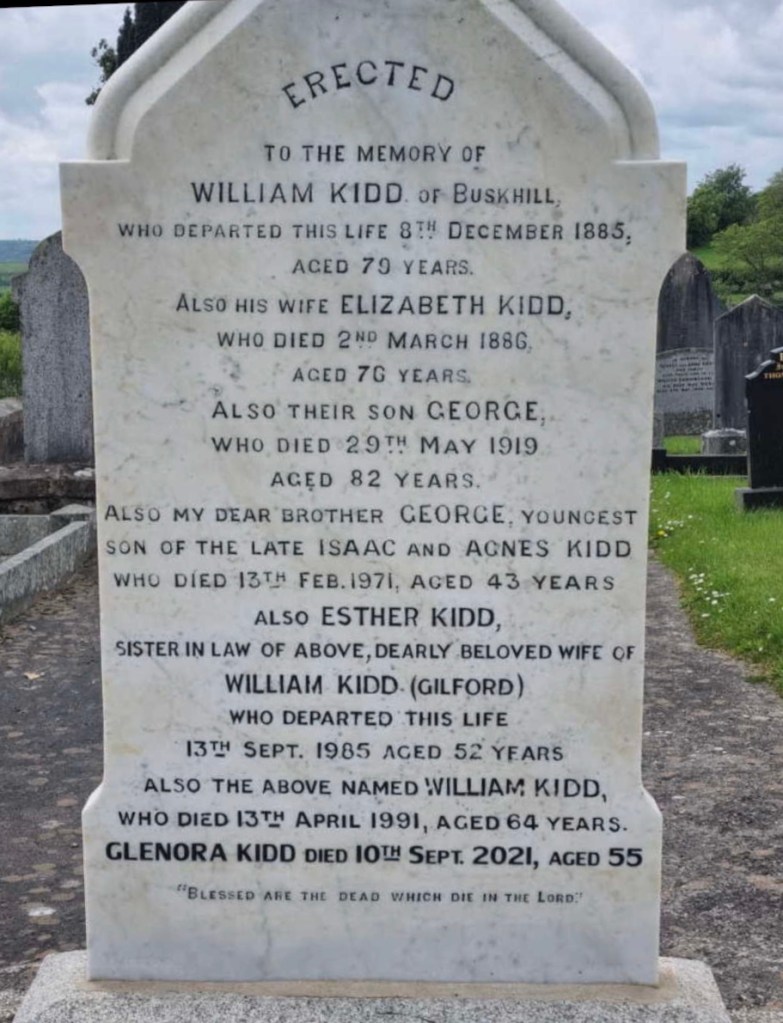
I first saw the copy of the will many years ago at PRONI, when I was looking for records of my own great-great grandfather, William Kidd 1805-1885, a farmer of Buskhill, Parish of Donaghmore, whose gravestone in the Donaghmore Church of Ireland graveyard shows that he died in 1885 aged 79 (see left). I had no idea if either of the younger William Kidds mentioned in the will had any connection to ‘my William’. The will remained a tantalizing clue but, for a long time, it was nothing more.
Lucky Survival Number 2: Family News (with a little help from DNA)
In 2017 I had my father, Bertie (Hugh) McCracken, do an Autosomal DNA test with Family Tree DNA. Shortly afterwards I was contacted by a 27cM match (many possibilities of relationship, but about 3rd to 4th cousin), Gary Clements. Gary thought he knew how he and Bertie were connected. He was descended from Mary Ann Kidd, the niece of Draper Kidd, who is mentioned in the infamous will. Gary Clements’ family information showed that Bertie’s great grandfather, my great great grandfather, William Kidd 1805-1885 was Mary Ann’s brother. And what’s more Gary had six letters from the 1820s to 1830s to prove it. You can imagine my excitement on hearing about this.
Gary sent me transcript copies of the letters, but he did not specify their origin, only that a lady named Audrey, a descendant of another of the sisters, Agnes (Nancy) Kidd Buck, had sent them to him and that he forwarded them with her permission. Sadly, I never heard anything further from Gary, but I am grateful that he significantly helped my research.
What a privilege it was to read this correspondence, to understand more of the lives of the Kidd family in the early 19thcentury and to learn of the heartache caused by Draper Kidd’s will.
The letters were written to Nancy (Agnes) Kidd in Kingston, Ontario from 1828 through 1833 from her sister and brother-in-law, Jane Drake (nee Kidd) and James Drake in Derrycraw, Donaghmore and her brother John Kidd in Ringolish, Donaghmore. Initially they are mainly concerned with Nancy’s welfare as they hadn’t heard from her, then even more concerned as it turned out her husband, Robert Dick, and their two children had died of cholera. Plans were made to book her a passage home, but this never happened as Nancy remarried to Adam Buck and remained in Canada.
Then Uncle Draper Kidd died in 1830. Jane Drake outlines the will to Nancy (Kidd) Buck and describes the problems that the Kidd brothers are having with the executor of the will, James Harshaw.
It appears that Draper Kidd must have held the lease on two farms which had previously been occupied by his mother (at this point her name was unknown) and were now occupied by Nancy’s brothers, John and Isaac.
When John Kidd writes to Nancy again in 1831, he says. “I cannot tell you all the trouble I have had since Uncle Draper Kidd died. He had a will giving all his landed property to his Bastard son. We do not like that our father’s property should be given to a Bastard. I was Administrator to Grandfather and mother’s property. Isaac was in one. I took possession of the mention (? Perhaps should be mansion) house and farm, and now most of it is in crop. Uncle Draper intended to alter his will, but the Lord took him suddenly, after 24 hours sickness.
James Harshaw and John Young are executors. The landlord Mr. Vaughan wants to give grandmother’s house to his son and give me a farm on Draper’s land instead. We have been able to hold possession so far.”
There is a hint in one of the earlier letters, before Draper died, from John Kidd that there were previous property issues. He says “the property we have has been a great expense, but we have not got any settlement yet. You shall have an equal share when we get it.” Was he referring to his dispute with the landlord Vaughan, which may have been going on before Draper’s death, or was this something to do with an earlier will?
In 1832 Jane Drake writes to Nancy (Kidd) Buck that “Your brothers have been at law with the Executor James Harshaw and the Landlord Mr. Vaughin ever since, about the property that my father should have had many years ago. Our Brothers have the best side of the law as yet, but the case is not ended. They have the land still in possession. The case is to be tried in the Lord Chancellor’s Court in Dublin.”
Jane Drake further says that she and her sisters will not receive the money bequeathed to them until the court case is settled.
In 1833 John Kidd sends Nancy( Kidd) Buck details of the court case and the back and forth of the legal proceedings. And here the letters end.
Of course I have questions.
Did Nancy (Kidd) Buck keep the letters because of the court case? Was this proof that she was due an inheritance?
There is only one brief mention of a William in the letters, in 1831 John Kidd states that “William and I will go to your country next Spring as I hope we will have the case settled by this time”. as we know from later letters the case wasn’t settled and there is no evidence that William Kidd or John Kidd went to Canada. But is this William really “my William”? Other evidence suggests that he is. My father, Bertie, has DNA matches to descendants of Jane (Kidd) Drake, to Gary Clements who is a descendant of Mary Ann (Kidd Clark) and her husband James Clark, to the Buck family, descendants of Nancy (Kidd) Buck in Canada and also to descendants of Isaac Kidd of Ringolish.
“My William’s” birth is recorded in the register of Donaghmore Presbyterian Church in 1805 as the son of George Kidd and Matty (short form of Martha) Martin of Buskhill.
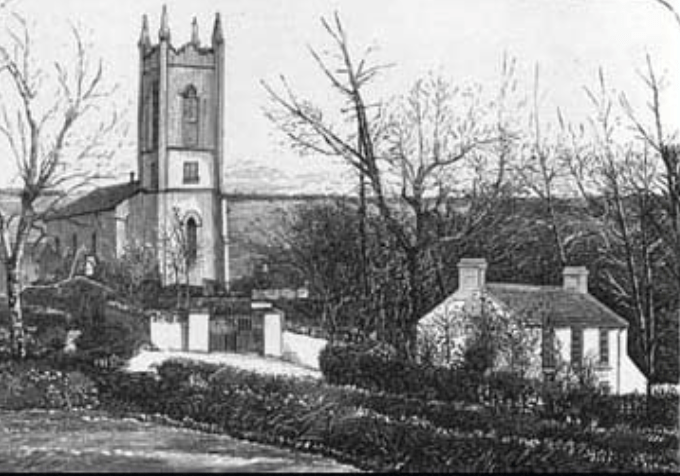
Another chid of George and Martha Kidd of Buskhill is recorded in the Donaghmore Church of Ireland (pictured left) register, Agnes baptized in 1803, probably the Agnes (Nancy) who is the recipient of the letters in Ontario.
But of course, as with so many genealogy clues, there are more questions than answers. It’s not clear why the children would be baptized in different churches. There are older records for the Church of Ireland church but no mention of other children from this family. The surviving Presbyterian records don’t start until 1804. Was there more than one couple named George and Martha Kidd in Buskhill? There are no census or other records to help us with this.
I’ll finish here for now with these questions floating in the air, grateful that I now know more about this family than I do about 90% of my ancestors. But the story does not end here, amazingly other records turned up that shed further light on this tale of disputed inheritance and they deserve their own post. Watch out for Inheritance Part 2.

 Gathering the Ancestors
One thought on “Inheritance”